Is ChatGPT safe for business? Business vs Enterprise vs API
ChatGPT is safe enough for most business work, but only on the right plan and with a few clear rules. We compare what Free, Plus, Business, Enterprise and the API do with your data, where the real risks are, and what to check for GDPR, HIPAA and other privacy laws.
Related service: AI automation for businesses
Is ChatGPT safe for business? The short answer
Yes, for most business work, if you use a business plan. ChatGPT Business, ChatGPT Enterprise and the OpenAI API do not train OpenAI's models on your data by default, encrypt it at rest and in transit, and come with a data processing addendum (OpenAI). Business costs $20 per user a month billed annually (OpenAI).
The bigger risk is not the tool but how people use it. On personal Free, Go, Plus and Pro accounts, OpenAI may use conversations to train its models unless the user turns that off. Employees who paste contracts or customer data into those accounts are the most common way company data leaks into AI.
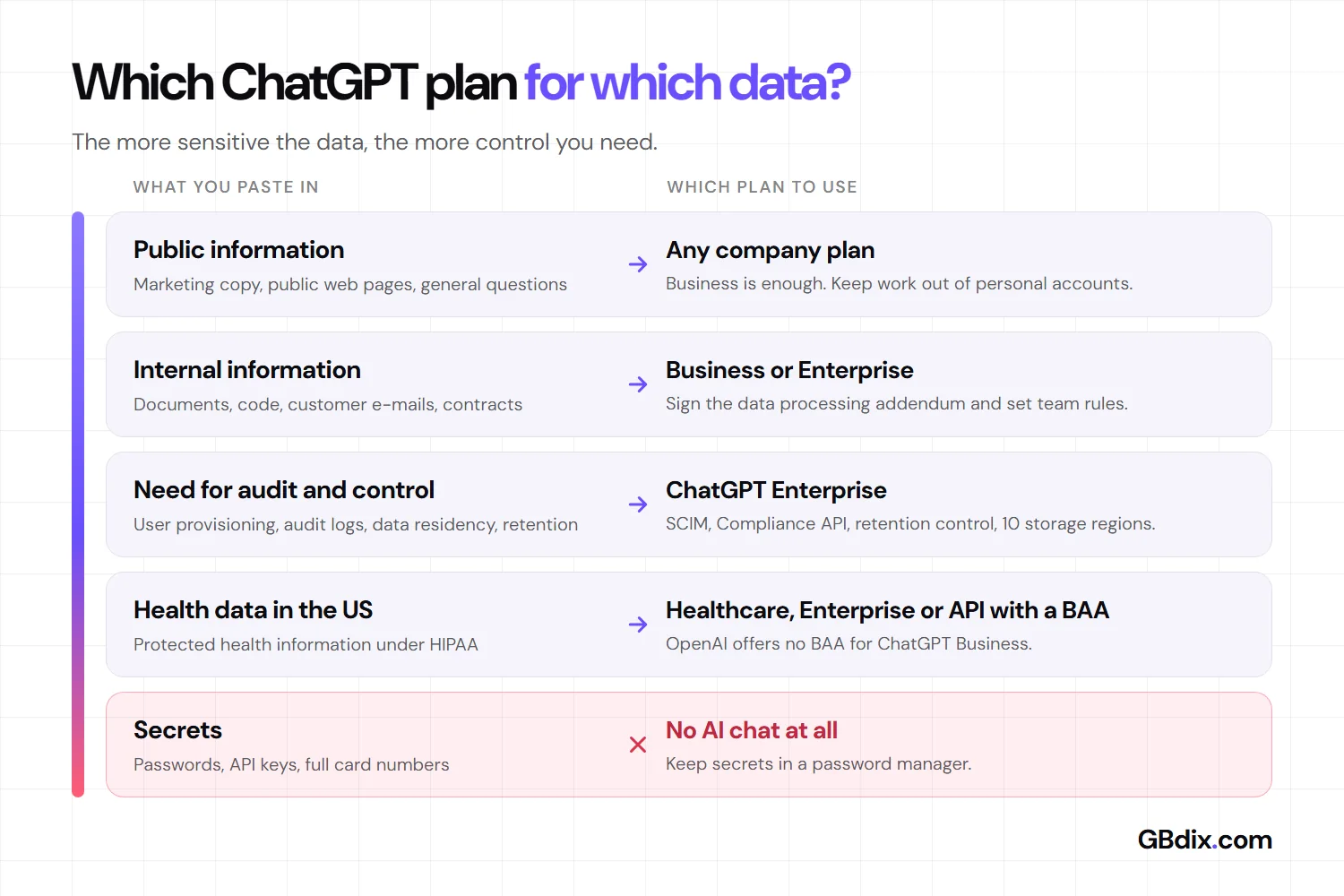
Choose Business for most small and mid-sized teams. Choose Enterprise if you need user provisioning, audit logs, retention control or data stored in a specific region. Use the API when you build AI into your own tools, especially with sensitive data.
ChatGPT plans compared: price and what happens to your data
| Plan | Price per user a month | Trains on your data? | Admin and compliance |
|---|---|---|---|
| Free, Go, Plus, Pro | $0, $8, $20, Pro $100 to $500 | Yes, unless the user turns it off | None. These are personal accounts. |
| ChatGPT Business | Standard seat $20 billed annually or $25 monthly; Premium seat $100 or $125. From 2 to 200 users. | No, by default | Admin console, SAML SSO, MFA, domain verification, SOC 2 Type 2, data processing addendum |
| ChatGPT Enterprise | Custom pricing | No, by default | Adds SCIM, Compliance API, IP allowlisting, retention control, data residency in 10 regions, ISO 27001 family, Enterprise Key Management |
| OpenAI API | Pay per use, billed separately from ChatGPT | No, by default (since March 2023) | Data processing addendum, 30-day abuse logs by default, Zero Data Retention on approval, BAA for healthcare |

The biggest risk isn't ChatGPT itself. It's staff using personal accounts for work.
The real risk: personal accounts at work
OpenAI says plainly that for its services for individuals it "may use your content to train our models" (OpenAI). A user can switch this off under Settings, Data controls, "Improve the model for everyone". Even then, a thumbs up or thumbs down sends the whole conversation for possible training. Temporary Chat is not used for training unless you save it as a regular chat, but OpenAI may keep it for up to 30 days for safety (OpenAI). Deleted chats are removed within 30 days unless OpenAI must keep them for security or legal reasons (OpenAI).
And people do use personal accounts. In Microsoft's 2024 Work Trend Index, 78% of AI users brought their own AI tools to work, 80% at small and mid-sized companies (Microsoft). In a 2025 study by KPMG and the University of Melbourne with 48,000 people in 47 countries, almost half of employees said they had uploaded sensitive company information, such as financial, sales or customer data, into public AI tools (KPMG).
Banning AI does not fix this. KPMG found uploads were most common where generative AI was banned. What works is giving people a company account and clear rules.
ChatGPT Business: enough for most small teams
ChatGPT Business, called ChatGPT Team until August 2025, is a shared company workspace for teams of 2 to 200 users (OpenAI). A Standard seat costs $20 per user a month billed annually or $25 billed monthly. A Premium seat gives five times more usage for $100 or $125.
OpenAI does not train on Business inputs or outputs by default, including data from connected apps, and signs a data processing addendum (OpenAI, privacy). You get an admin console, SAML single sign-on, multi-factor authentication and domain verification. Under OpenAI's terms you own your inputs and the outputs (OpenAI).
Three things to know before you buy. Apps such as Google Drive or SharePoint are enabled by default in Business, so admins should review which ones the team can use (OpenAI). OpenAI's documentation on Business data retention is inconsistent, so do not count on custom retention settings. And OpenAI's privacy page says Business admins can view, export and delete members' conversations, while its Business help pages say admins cannot see members' private chats by default but owners can export a member's data. Either way, tell your team that a work account is not private (OpenAI, help).
ChatGPT Enterprise: control, audit and data residency
Enterprise adds what larger or regulated companies need: SCIM user provisioning, custom roles, IP allowlisting, the Compliance API for audit logs, and ISO 27001, 27017, 27018 and 27701 certification on top of SOC 2 Type 2 (OpenAI). Workspace admins decide how long data is kept, and deleted conversations are removed within 30 days (OpenAI). Larger customers with an OpenAI account representative can manage their own encryption keys (OpenAI).
New Enterprise customers can store data at rest in the US, Europe, the UK, Canada, Australia, Japan, South Korea, Singapore, India or the UAE, at no extra cost (OpenAI). Processing on GPUs stays in-region only for the US, Europe and the UAE, and some features, such as web search and third-party apps, fall outside residency. Enterprise pricing is by quote, and nonprofits get up to 75% off Business or Enterprise.
The OpenAI API: when you build AI into your own tools
If you connect AI to your own CRM, helpdesk or document workflow, you use the API, not ChatGPT. Data sent to the API has not been used for training since 1 March 2023, unless you opt in (OpenAI). By default OpenAI keeps abuse-monitoring logs for up to 30 days.
For sensitive data you can apply for Zero Data Retention or Modified Abuse Monitoring, which need OpenAI's approval. Zero Data Retention does not cover every feature: stored conversations, assistants, uploaded files and vector stores keep data until you delete it. Data residency for API projects is available in the same regions as Enterprise, but regions other than the US need extra approval, and models released since March 2026 cost 10% more with data residency.
The API gives you the most control, because your own system decides what data reaches the model, who can trigger it and what gets logged. It also needs someone to build and maintain that system.
ChatGPT Business vs Enterprise: security features
| Feature | Business | Enterprise |
|---|---|---|
| No training on your data by default | Yes | Yes |
| SAML SSO, MFA, domain verification | Yes | Yes |
| SOC 2 Type 2 | Yes | Yes |
| ISO 27001, 27017, 27018, 27701 | No | Yes |
| SCIM user provisioning | No | Yes |
| Custom roles and group permissions | No | Yes |
| Compliance API and audit logs | No | Yes |
| IP allowlisting | No | Yes |
| Data residency in 10 regions | No | Yes, for new customers |
| Enterprise Key Management | No | Yes, with an account representative |

Deleted chats are not always gone. Here is the case that showed it.
Deleted is not always deleted: the New York Times case
In May 2025, in the copyright lawsuit brought by The New York Times, a US court ordered OpenAI to preserve ChatGPT and API conversations, including deleted ones. The order covered Free, Plus, Pro and Team (now Business) users and API customers without Zero Data Retention. Enterprise and Edu customers and Zero Data Retention API traffic were not affected (OpenAI).
OpenAI says the obligation ended on 26 September 2025 and it returned to its normal retention. Data from April to September 2025 remains under legal hold. In January 2026 a court also upheld an order for OpenAI to hand over a sample of 20 million de-identified user logs (National Law Review).
The lesson for companies: any provider can be ordered to keep data longer than its policy says. The plans with contractual retention control, Enterprise and Zero Data Retention on the API, were the ones that stayed out of it.
Incidents worth knowing about
- Samsung, 2023. Engineers pasted internal source code into ChatGPT, and Samsung banned staff from using generative AI tools (CSO Online).
- Bug in March 2023. Some users could see titles from other users' chat histories, and payment details of 1.2% of Plus subscribers active in a nine-hour window were exposed, without full card numbers (OpenAI).
- Shared chats in search results, 2025. Shared links that users had marked as discoverable appeared in Google. OpenAI removed the option (Search Engine Journal).
- Analytics vendor breach, November 2025. An attack on Mixpanel exposed names, e-mail addresses and metadata of API users and of a limited number of ChatGPT users who had contacted support. No chat content was involved (OpenAI).
- Data leak flaw, fixed February 2026. Check Point showed that a malicious prompt could quietly send conversation data out. OpenAI fixed it, with no sign of use in the wild (Check Point).
- Prompt injection. Instructions hidden in a web page or document can steer an AI agent. OpenAI calls it "a hard, open problem" and says its safeguards do not remove all risk (OpenAI, agent help).
GDPR, HIPAA and other privacy laws
With Business, Enterprise and the API, OpenAI processes data on your behalf, so you are the controller and need its data processing addendum (OpenAI). For people using personal accounts in the European Economic Area and Switzerland, the controller is OpenAI Ireland Limited, supervised by the Irish Data Protection Commission (OpenAI).
Regulators are active. Italy fined OpenAI €15 million in December 2024, and a Rome court annulled the fine in March 2026 because oversight belongs in Ireland, without ruling on the processing itself (WSGR). In May 2026 Canada's privacy commissioners found that the way OpenAI initially trained ChatGPT did not comply with their privacy laws. The federal commissioner considers the issue conditionally resolved after OpenAI's changes (OPC).
For US health data under HIPAA, OpenAI offers a Business Associate Agreement for ChatGPT for Healthcare and for API customers, and Enterprise or Edu customers can request one through sales. OpenAI says it does not offer one for ChatGPT Business (OpenAI, BAA). If your company operates in the EU, the AI Act has also required since 2 February 2025 that companies using AI take steps to build their staff's AI literacy. Since a July 2026 amendment, no specific level is required, and national authorities can enforce the rule from 2 August 2026 (European Commission).
Whatever the country, the questions are the same: where the data is stored, who can access it, how long it is kept, and whether your privacy notice tells customers that you use AI.

Copy these rules into your team's AI policy.
A ChatGPT policy for your team in 8 rules
- Company accounts only. No work content in personal Free or Plus accounts.
- Sort data into three groups: fine to paste, paste only into the company workspace, never paste.
- Never paste secrets: passwords, API keys, full card numbers, ID documents.
- Remove names when the task does not need them, for example when summarising a customer complaint.
- Review the connected apps in the admin console and switch off what the team does not need.
- Turn off public sharing of conversations if your plan allows it, and delete shared links you no longer need.
- Check every output that goes to a customer, into a contract or into the accounts. AI can be wrong with confidence.
- Train people for an hour and write down who uses AI for what. In the EU this is part of AI literacy.
Frequently asked questions about ChatGPT security
Is ChatGPT safe for business use?
Does ChatGPT Business train on my data?
Is ChatGPT Plus safe for confidential company data?
What is the difference between ChatGPT Business and Enterprise?
How long does OpenAI keep ChatGPT conversations?
Is ChatGPT GDPR compliant?
Can I use ChatGPT with patient data under HIPAA?
Can my company store ChatGPT data in Europe, Australia or Canada?
Can my admin read my ChatGPT Business chats?
When ChatGPT is not enough
ChatGPT is a good assistant, but it does not know your CRM, price lists or open orders unless someone pastes them in. When a task repeats every day, such as answering customer e-mails, processing invoices or preparing quotes, it is usually safer and cheaper to connect AI to your systems through the API. Then your system decides what data the model sees, and nobody copies data by hand.
At GBdix we build these connections for companies in Europe and beyond. Tell us what your team does manually and we will tell you whether ChatGPT Business is enough or a custom tool pays off. If you are deciding between buying software and building it, read custom software vs SaaS.
Sources
- OpenAI plans and prices: business pricing and plan comparison, Business FAQ, Business data and privacy, Plus, Pro, Go
- OpenAI data and privacy: enterprise privacy, business data, how your data is used to improve models, API data controls, data residency, Temporary Chat, chat retention, apps in ChatGPT, Enterprise Key Management, BAA for the API and ChatGPT, trust portal, services agreement, EU privacy policy
- Court case: OpenAI on the New York Times data demands (updated 22 October 2025), National Law Review (January 2026)
- Incidents: OpenAI, March 2023 outage, OpenAI, Mixpanel incident, OpenAI, prompt injections, Check Point, CSO Online on Samsung, Search Engine Journal on shared chats
- Regulators and law: WSGR on the Italian ruling, Office of the Privacy Commissioner of Canada, European Commission, AI literacy
- Surveys: Microsoft Work Trend Index 2024, KPMG and University of Melbourne, Trust in AI 2025

Want AI that works on your own data?
We build AI tools that work inside your CRM, documents and accounting through the OpenAI API and its business data controls, so your team stops pasting company data into chat windows. First we tell you honestly whether ChatGPT Business is enough.

Source: GBdix · Published 9 November 2026